Pays d'Auge Calvados: How It Differs From Ordinary Calvados and Regional Cider
Pays d'Auge calvados is one of the three appellations of this Norman brandy. You can explore its home ground on the cider route, a loop of about 25 miles. Where does the difference from ordinary calvados come from? The answer lies in the distillation and in where the cider comes from. This article explains what these drinks are, how to read the statements on a bottle and where to find cider from the Pays d'Auge.
What Is Calvados, and Which Appellations Exist?
Calvados is a Normandy brandy made by distilling cider or perry, the cider made from pears. The calvados AOC dates from 1942. Since the simplification of 1984, three appellations remain: calvados, Pays d'Auge calvados and Domfrontais calvados, the last of which received its AOC in 1997.
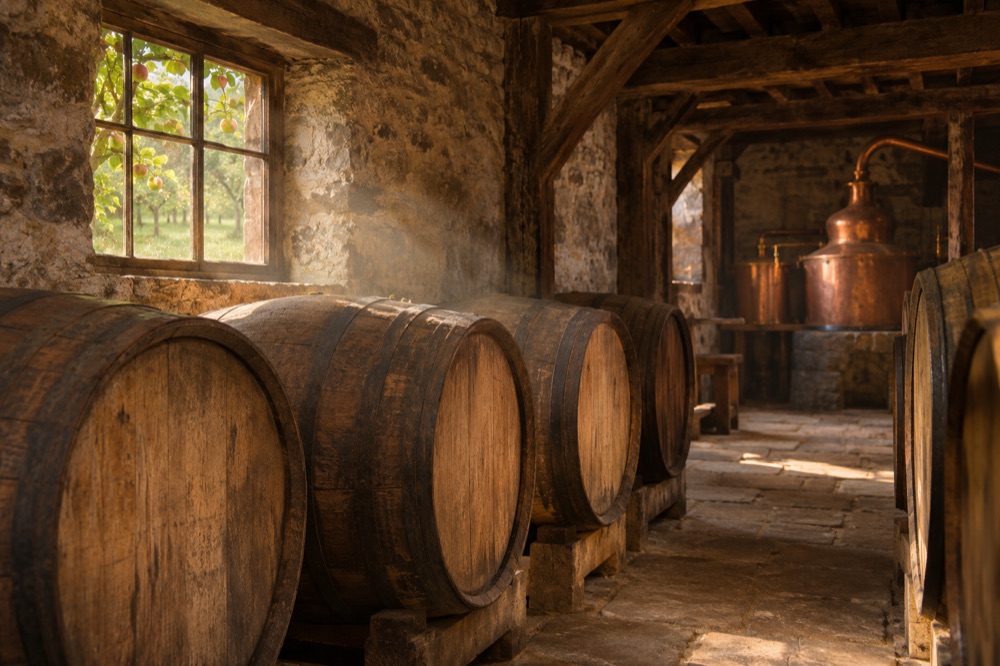
The raw material is highly varied. There are around 230 varieties of cider apples and 139 varieties of perry pears, so the character of the spirit depends on the appellation but also on the choice of fruit. Every calvados must age at least two years in oak casks, which gives it its amber color. That requirement is the starting point for all the age statements described below.
Pays d'Auge Calvados: Double Distillation
The essential difference lies in the making. This appellation requires double distillation of Pays d'Auge cider, whereas the plain calvados appellation allows single or double distillation. The producer of an ordinary calvados therefore has more freedom, while for Pays d'Auge the rules are stricter.
That counts when choosing a bottle. With an ordinary calvados it is worth checking whether the distillation was single or double, because the appellation does not say. With the Pays d'Auge name, the appellation gives the answer. It says nothing, however, about how long the spirit aged, which is why it pays to read the age statements as well.
How to Read the Age Statements
The scale is clearer when you go through it in order. VS means at least 2 years of aging. The statements Vieux and Réserve require at least 3 years, and VSOP, or vieille réserve, 4 years. From 6 years on, the term is très vieille réserve, which can also appear under the labels XO, Napoléon or très vieux.
Remember that age indicates a minimum time in the cask. A younger calvados is not worse: it is simply another style, and the choice depends on the occasion and personal taste. Sensible limits apply too, since this is a strong spirit, to be enjoyed in moderation.
Pays d'Auge Cider: What Sets It Apart?
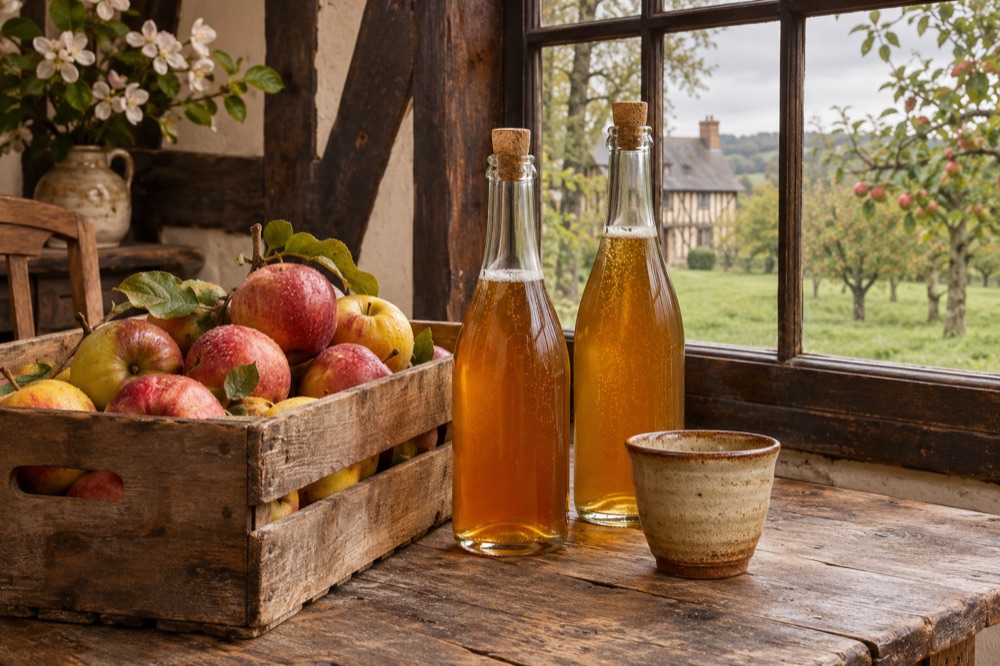
Pays d'Auge cider holds a protected designation of origin (PDO). It is sparkling, unpasteurized and not artificially carbonated. Its bubbles come from a second natural fermentation, the prise de mousse, which takes place in the drink itself with nothing added from outside. It is made only from pressed apple juice, with no shortcuts possible.
Each of these conditions contributes to its character. Cider is not a distillate: it is a sparkling drink, which distinguishes it from calvados, even though the latter comes from it. It is easy to see why the two products are so often presented together.
Cider production is concentrated in the cantons of Cambremer, Saint-Pierre-sur-Dives, Livarot and Vimoutiers. That is where Pays d'Auge cider and calvados are born from a single orchard tradition. For many visitors, cider is the first step in discovering local drinks, since everything starts with it.
Why Take an Interest in Pays d'Auge Calvados?
The first appeal is the clarity of the rules. This appellation requires double distillation of Pays d'Auge cider, so there is no need to guess how the drink was made. With an ordinary calvados that information is sometimes vague, whereas here it follows from the name.
The second is a coherent tradition. Pays d'Auge cider and calvados come from one region. Discovering them together shows how a single orchard yields two drinks, one sparkling, the other aged in oak casks. The third is the age scale, which serves as a guide for reading labels, from VS to XO, Napoléon and très vieux. That knowledge is useful whatever the appellation of the bottle.
The Cider Route: Discovering the Region on the Ground
The cider route is a loop of about 25 miles through the Pays d'Auge. It passes through Beuvron-en-Auge, Cambremer and Hotot-en-Auge, among other places. Cambremer is more than a stop: it is also the name of one of the cantons where cider production is concentrated.
The route lets you see the landscape the apples come from and understand why the region is so closely tied to cider. The details on a label, such as the appellation or the method of distillation, then take on a concrete meaning. Before setting out, it is best to look up current information on the places you want to visit.
More articles on the region await, and Pays d'Auge calvados is a good starting point for further reading.